Wednesday, April 30, 2014

A Scientific Epistemology

Near the end of a long discussion of "privilege" on Facebook today, I said that there is an "epistemology" that offers something better than telling white males to shut up because their "privilege" is showing. "Epistemology" is the branch of philosophy that deals with truth and knowledge--what can we know and how do we know it? I argue that 21st century science provides a new way of thinking about "knowledge" that opens the door to a more deeply human way of thinking. Buckle your seat belts!
Philosophers have been talking about "ideas" for thousands of years, but scientists have only began to figure out the PHYSICAL nature of ideas in the last few decades. The science of "neural networks" has analyzed how nerves interact to enable creatures with brains to react and adapt. Engineers have been able to build devices that use this science to identify objects, make choices, and adapt to changes. While no artificial neural network is even remotely up to human cognition, the basic building blocks are increasingly well understood.
One may think of two nerve cells as defining a two-dimensional plane (scientists refer to this as a "phase space") in which all the possible states of these two nerves may be charted out. Add another nerve cell and you need a third dimension. Add more nerves and you need more dimensions--lots more. By the time you try to map out a human brain, you need 100 billion dimensions. This "hyperdimensional phase space" describes an ENORMOUS set of possible brain states. The WAY the nerves are connected affects the "shape" of this space, so one human mind may be described as a hyperdimensional space with a shape far more unique than any fingerprint.
Words, in this model, are individual locations within this space. When you read the word "banana," a set pf nerve cells start to signal. These signals can be "mapped" to one area in your unique phase space. The same word causes my nerve cells to start signalling, too, but of course the wiring in my brain is very different from yours. Your hundred billion cells are firing in one way; my hundred billion are firing in a different way; which adds up to TWO hundred billion cells firing at the same time in an even more complex pattern.
The key to my alternative epistemology is to knock down the barrier between brains. When two minds are both processing the same word ("banana" or anything else) they are both part of a TWO-hundred-billion dimensional phase space. Add another human and you add another hundred billion dimensions. In this model, a word, phrase, or statement "means" one particular point in a phase space made up of multiple minds.
That's the SCIENCE behind this new way of thinking about thinking. Let's look at the implications.
When I say "banana," you may visualize bright green fruits with bright yellow stickers under bright lights at the local Trader Joes, or mashed bits of slime all over your toddler's plastic tray, or browny-black shriveled lumps in the fruit bowl that you can't stand to touch long enough to throw away. That's a suburban American take on "banana." But a Central American farmer might see a whole world of different images--slimy slick banana shoots; huge scary spiders; cash on the table for the rent. "Banana" means the ENTIRETY of these images, not just MY experience, or yours, or the peasant farmer's.
The "check your privilege" approach that I challenged earlier today tends to discount the suburban view of "banana," preferring the viewpoint of the oppressed or under-represented. My approach, in my opinion, keeps the GOOD part of the "check your privilege" approach without silencing the "privileged" in the process. It is GOOD for the affluent white American male to expand his understanding of "banana" (or anything else), but he doesn't have to disclaim his OWN experience to do so.
Bananas aren't really all that exciting--as food or philosophy. How about a more controversial word, like "rhubarb"? Some people love rhubarb, others hate it. We tend to treat "I hate rhubarb" as a SUBJECTIVE statement, with no "right" or "wrong" content. But our neural network approach allows us to see that "I hate rhubarb" reveals a richer, truer grasp on reality. The hyperdimensional space made up of many different minds includes a point labeled "rhubarb" which powerfully connects with "I love rhubarb" AND with "I hate rhubarb." One might visualize this as two roads intersecting at one junction. This tells us something real and important about rhubarb--which the simpler characterization of "subjective" left out.
The point of this post, of course, is not to talk about fruits and vegetables, but about truth and justice. "Justice," like "rhubarb" is a word that seems "subjective." If "rhubarb" was an intersection of two roads in the hyperdimensional phase space made up of all our minds, "justice" is Grand Central Station--there are roads, rails, buses, and subways coming in from all directions at this point. That does not mean that "justice" is "subjective." It just means that it takes ALL our minds to grasp every nuance of the word.
Whether you agree with any of what I have outlined above, you'll find that I try to apply this philosophical approach to meaning, knowledge, truth in all my FaceBook posts. I am eager to hear what you have to say, even if you disagree with me--in fact, especially if you disagree with me!--because I view this FaceBook page as hyperdimensional phase space where our many minds create a single conversation. If you LIKE the way that conversation goes here, you might take a longer look at the REASON it goes this way.

Monday, March 31, 2014

Noah and the Nephilim

The new "Noah" movie has people talking about "Nephilim" (the rock monsters in the movie), which are supposed to be fallen angels which have taken on physical form. This may seem like the most fantastic part of an extraordinarily far-fetched plot, but I have been persuaded that it is probably the correct reading of some obscure bits of the Bible. Passages in Second Peter and Jude all persuade me that some of the New Testament writers actually believed that demons had taken on physical form before the Flood.

If you don't believe in demons, that makes the New Testament that much more mythological, but if you are open to the possibility that angels (and by extension, demons) might exist, then it fits into the broader story of the Bible reasonably well. The Gospels and the Book of Acts are full of references to demons and/or "demonized" humans, who routinely confess that Jesus is Lord and then are cast out. The letters of Paul are full of references to the "powers and principalities" and "forces of darkness," which he unquestionably intended to mean hostile, non-human intelligences. If you believe the Bible, you believe in demons.

But does that mean that demons can "incarnate," i.e., take on physical forms of their own as opposed to manipulating human beings? This has been an open question for centuries, as theologians have struggled with Genesis 6:2, which says that "the sons of God" took "the daughters of men" and produced offspring called the "Nephilim." The primary competing theories about this passage are (a) the "sons of God" are the line of God-fearing descendants of Adam's son Seth or (b) the "sons of God" are angels (specifically, fallen angels; see Job 1).

While I have the greatest respect for the orthodox Evangelical theologians who believe that the "sons of God" were human, I think St. Peter and St. Jude believed they were fallen angels. Given the choice between any modern theologian and an apostle, I'm going to side with the apostle. So I read Genesis 6 to say that demons took on physical form in the days before the Flood.

If you don't believe Genesis, that makes the Old Testament that much more mythological, but... what if this is one of those cases where history became legend, and legend became myth, and things that should have been remembered were washed away in the Flood? That is the premise of Ellen Gunderson Traylor's book, "Noah," which casts Poseidon as a major character--an incarnated demon whose body is destroyed by the Flood.

Monday, January 13, 2014

A Punctuated Participatory Anthropic Hypothesis

My dearest far-left friend is holding an anti-Creationist rant on her Facebook page today, so I will take the bait and post my current working hypothesis on human origins. I know I'm just trolling for trolls, but life is too short to lurk. I will begin with my two reasons for questioning the conventional Darwinian wisdom.

The evidence of the occult

First, I am persuaded by the evidence that Jesus rose from the dead. If that happened, then there is more to this universe than mere time, space, matter, and energy. I'm not going to try to persuade today's readers that I am right, but I will note that the "methodological materialists" who refuse to even consider the possibility of any other entities necessarily rule out all testimony about occult or supernatural events.

If we decide in advance that ghost stories are necessarily false, then we don't need to question whether materialism explains everything. If we are willing to listen to stories about hauntings and other immaterial events, however, then we do need to question mere materialism.  Since I believe the story about the resurrection of Jesus, I am open to events that can't be explained by physics. When I listen to the stories from people throughout time and around the world, I find as much reason to believe the "spiritualists" as I do to believe the "materialists."

The mathematical problem

Second, I used to believe that Darwinian evolution was an elegant hypothesis that explained the evidence--until I did the math. I won't bore you with calculations here, but I'll state the issue: evolution can't begin until there is something that is capable of both (a) replication and (b) mutation. John von Neumann (who invented the modern computer) did a series of lectures at Harvard in the 1950s which treated life as a form of information, and he computed the theoretical minimum length of "cellular automata" that could reproduce after a mutation. He came up with a minimum "program" of 1400 bits. 

If you accept von Neumann's number and can do math involving exponents, you will conclude, as I did, that either (a) there is a single universe and the existence of life is proof of the existence of God, or (b) this is just one of an infinite number of universes and life is a mathematical necessity (since an infinite number of chances will give you every possible outcome, including this one).

My current working hypothesis of origins

My own hypothesis combines the evidence of immaterial activity with the possibility of multiple universes. It is a variation of a hypothesis of John Wheeler (who coined the term "black hole"), which he called the "participatory anthropic principle." 

The participatory anthropic principle starts with the principle of quantum physics that holds that any system of particles is a cloud of overlapping possibilities until that system is "observed," at which point it "collapses" into an actual state. Wheeler asked, "what happens in a universe that has no observers?" It would seem that the entire universe would be a system of particles in a cloud of overlapping possibilities until an "observer" emerged to "collapse" it all. Wheeler suggested that the "observer' was one of the possibilities, and that the observer's own observation was the reason the universe has an actual state (with an observer in it) rather than remaining as a quantum cloud.

Wheeler's suggestion was brilliant, but it isn't "science." Science consists of questions that can be answered through some experimental method, not "just-so stories" that are necessarily untestable, no matter how well-supported they may as a matter of theory..

The hypothesis that I am about to advance pushes Wheeler's hunch a bit further in order to make it testable. Note--I am not arguing that my hypothesis is better than Wheeler's hunch, just that my hypothesis is "scientific" (because it can be tested) whereas Wheeler's is not. Ironically, my "scientific" hypothesis comes directly from the text of Genesis 1.

Genesis does not tell us that humankind popped into being in a single participatory leap from the Big Bang. It spells out six steps, with man as the last. This led me to question Wheeler's hunch--if the universe is a vast quantum computer "programmed" to produce an "observer," why should that "observer" do anything more than flare into existence for one moment of consciousness and then vanish just as quickly? A cloud of perfectly arranged ions in space might function as a neural network for one instant--and the universe would "collapse" into the kind of universe that has ion clouds. But the next moment, the ions would disperse and we would be left with an "unobserved" system for a long time.

I call this the "bowl of petunias" problem, named after the scene in Douglas Adams' "Hitchhikers Guide to the Galaxy" where the infinite improbability drive creates a sperm whale and a bowl of petunias miles above the surface of a planet. 
Curiously enough, the only thing that went through the mind of the bowl of petunias as it fell was Oh no, not again. Many people have speculated that if we knew exactly why the bowl of petunias had thought that we would know a lot more about the nature of the universe than we do now.
As you can see, my hypothesis explains exactly why the bowl of petunias thought this--in a participatory anthropic universe, the existence of consciousness does not imply its continuation. "I think, therefore I am--briefly!"

My hypothesis is that the six days of Genesis 1 refer to six "observer-driven" events. The first two involve the emergence of what the Bible calls "angels" and "demons." I don't expect anyone reading this to buy into that, but I do note that the existence of immaterial intelligences would explain why anybody should bother with anything the book of Genesis says. If there are intelligent aliens (of any sort) and if they have ever communicated with humans, that communication is worth examining. My proposal  explains where the aliens came from and how they have communicated with us--but this part is not a "scientific" hypothesis because there is no way to test it.

The scientific part kicks in with the third through sixth days of Genesis, which deal with biological life. According to my hypothesis, plant life emerged on some other planet on Day Three--and these plants were "observers." Imagine a sentient pomegranate on a distant planet, drinking in sunshine and pondering the meaning of life. It's a peaceful scene, although an intelligent fruit isn't able to "observe" much beyond its own consciousness, and therefore has little effect on the overall unfolding of the quantum cloud.

Pollen grains are fascinating items--I will spare my readers any discussion of the "alternation of generations" or the interstellar potential of such genetic carriers. It is enough to suggest that pollen grains could seed an entire galaxy with life in a version of panspermia. A single haploid pollen grain falling into a lifeless ocean might colonize an entire planet. If two haploid units came together into the full diploid form, the sentient fruit would cause the system to collapse into a form capable of supporting multicellular life, but would not otherwise affect its environment.

In Genesis, Day Four describes the appearance of the sun and moon, with stars for "signs and seasons." In my hypothesis, this event occurred during the Cambrian explosion when a squid-like creature looked up through its remarkable eye and saw the skies. Octopi are fantastically intelligent--but have tragically short life-spans.  For one reason or another, the first octopus observer was also the last--and since then, octopi have been bait for faster predators.

Day Five of Genesis says the oceans swarmed with fish and the skies with birds. Parrots are as intelligent, in their way, as any other animal. An African Grey  parrot named Alex was able to count, do simple arithmetic, and use words in context. In my hypothesis, birds arose before the therapsid dinosaurs, which are their simple-minded, warm-blooded descendants.

On Day Six, humans and other land animals arose. I picture a set of footsteps across a sandy beach of the Black Sea punctuated by an instant in which a hominid became a human. I'll skip the scene where a human and a "serpent" and a fruit tree come together--that's religion, or history, or both--in order to explain why all this is science.

Testing the Punctuated Participatory Anthropic Hypothesis

Science can be tested by experimental means. Other ideas, no matter how closely associated they may be with scientific knowledge, are philosophy (or theology), not science. Thus, the claim that the universe consists exclusively of space, time, matter, and energy is a philosophical statement, not a scientific statement--because it cannot be put to a scientific test.

By contrast, the claim that birds were created after squids but before humans in a punctuated participatory anthropic fashion is testable. Observer-driven evolution (ODE) has a distinct pattern of development which is quite different from neo-Darwinian evolution (NDE). ODE is characterized by a statistically-impossible accumulation of changes leading to intelligence, with "adaptive radiation" outwards from the main line of evolutionary advance. It "looks" like an umbrella, with a handle going "up" and species all coming "down" from the most advanced line. NDE is characterized by  broad horizontal diversity with agonizingly slow upward creep--visually, a very wide upside-down pyramid.

In the past, there wasn't much scientists could do to tell whether living species better fit the umbrella or upside-down pyramid model, but DNA sequencing now enables us to see which model is the better fit. Michael Denton's 1985 book, Evolution: A Theory in Crisis, did not have the punctuated participatory anthropic hypothesis to guide his work, but he notes a number of anomalies that led him to question the neo-Darwinian model. I submit that the evidence Denton noted supports the punctuated participatory anthropic model and suggests further study along those lines.

Conclusion

Genetic comparison of mammalian, avian, and cephalopod fossils and DNA could support or undermine these fundamentally different models of evolution. If the evidence does suggest that birds came first and that octopus eyes are genetically related (not merely functionally similar) to mammalian eyes, then perhaps we should reexamine human stories of occult events. It may turn out that ghost stories are evidence, too.

Wednesday, January 02, 2013

Art History


Nicole thought she knew security systems, but the Louvre had nothing on this twentieth level sub-basement. The six men around the conference table looked as serious and deadly as the unnamed agent who had whisked her from her office at the Smithsonian this morning. (Was it only this morning?) Now they leaned forward, as if the fate of the world hung on what she had to say. She wondered if she looked as nervous as she felt.

"The fine arts--particularly painting--have had a tremendous impact on human culture over the centuries--" She didn't even make it to the end of the first sentence of her scribbled script.

"Skip the intro, Dr. Maven." The man she only knew as "The Colonel" cut her short. "You may not recognize the men around this table--I certainly hope you don't--but the CIA has made sure that each one knows more about human culture than the average university faculty. We've invited you here to talk about the impact of just one artist--the one you've built your career around."

"Invited?" Nicole didn't respond well to rudeness, arrogance, or pressure, and this secret room was overflowing with all three. "I don't remember being asked to come here. In fact, I was supposed to give a lecture this afternoon and I have no idea if anyone filled in for me."

"Your talk on 'The Sound and Fury of Canvas" was replaced by Dr. Ian Berkeley's more general "Mid-Twentieth Century Volk Art." 

"Well, that's a relief."

"You may not trust us in any ultimate sense, but I think you can rely on our staff here at Langley to pull off a simple reprioritization of personnel resources. We need you here--and so, although they don't know it, do the tourists at the Smithsonian who missed your lecture this afternoon.

"I'm flattered, of course, but I can't imagine the government's sudden interest in art. Has somebody stolen a famous painting or something? Don't tell me they've done something to "Struggle for the Soul of the Nation!"

"No, it's on display in Munich--twenty-four hours a day. The viewing line stretches for blocks away from the Alte Pinakothek. We need you to tell us why ordinary Germans who work all day are willing to stay awake all night to view one picture."

A heavyset man leaned forward. His dark glasses seemed silly in the darkened room, but he seemed anything but. "Is it something special about Germans? Is that why they keep coming back?"

Nicole drew up short. The question was outrageously incorrect! "Oh, I doubt that..." Her sentence trailed off weakly. "I've honestly never considered the possibility."

"Really? You've studied this man's art and never explored it's relation to his culture?"

"He's actually Austrian, you know."

The heavy man waved her technicality away with the contempt it deserved. "His art is German, and his audience is German--and those who want to be."

"Those who want to be?"

The man in charge frowned. "Dr. Maven, you're the first female expert we've had to invite before the panel. The men we've had down here seemed to instantly understand why the CIA is interested in art. Are you really this naive, or are you just being coy?"

Nicole Maven pulled herself up to her full height of five feet, two inches, and tried to look intimidating. "I don't have to put up with this sexism!"

"Doctor, that door is locked. There are four armed guards outside it. You're twenty floors below the most secure building in America, and we're here to defuse a cultural crisis that threatens civilization as we know it. So, at the risk of being blunt, you do have to put up with this sexism or anything else we may need to save this planet."

"That's absurd!"

"No, it isn't. I'll tell you what's absurd. There's a man with a brush whose pictures have inflamed Europe, South America, and the Pacific Rim. There are riots when his paintings are put up, and more riots when they are taken down. It's unprecedented, uncontrolled, and it's growing every day. We're here to stop it."

Dr. Maven bent her head. "I don't disagree with your description, but you can't be serious."

"I assure you, we're completely in earnest."

She laughed. "But how? You can't stop art! Censor it--especially his art--and it will only grow faster. It's not like he's painting the Mona Lisa, you know--his work is all about symbols. The cheap copies you see on T-shirts are more effective than his originals!"

"This is the CIA, Doctor. We aren't limited to burning paintings."

"Oh!" She paled. "But that wouldn't work! Assassination won't stop his work. Art feeds on martyrdom--you'd only make him ten times more popular!"

"Perfectly correct, Dr. Maven. We have no interest in hurting anybody--or any no need to."

"But how can you stop the man, or his art, without hurting him?"

The man in charge looked around the room. "I'll answer that question, and anything else you want to know if you can tell me that, in your expert opinion, this man is a genuine threat to western civilization."

The heavy-set man banged his fist on the table. "Tell her?" He looked at the others in disbelief. "You can't do that!"

The Colonel stared him down. "Yes, I can--for reasons that you should be able to figure out for yourself with a minimum of effort." He turned back to Nicole. "Is he a threat?"

"Not so fast!" she gasped. "Are you going to kill me after you tell me everything?"

"No." It was the heavy-set man who answered, with a look of grudging admiration for the Colonel. "No, he's telling the truth. We won't do anything to you. You'll be perfectly free to go and nobody will interfere with you once you leave."

She looked around the room. The others mostly wore puzzled looks, but one by one they figured out the mystery and nodded. "You'll be perfectly safe," they agreed.

"But if he's not a threat--"

"Then say so, and nothing happens. You leave and we go on to other matters."

She hesitated. The room was silent, all eyes on her. It seemed she had felt this way before--oh, yes, at the top of ski jump at Kitzbuhl. She hoped this went better than that had! 

"In my opinion," she began, "this painter's popularity is unprecedented, and therefore his impact is unpredictable. We know how writers change the world--The Sorrows of Young Werther  produced a rash of teenaged suicides, and the Communist Manifesto sparked the Russian Revolution. But a picture is worth a thousand words--in theory, this man could have a thousand times the impact of Karl Marx."

"He is a threat, then?"

She trembled a little. "Undoubtedly."

The room was silent again. She waited, unwilling to demand her "pay" for her opinion. The Colonel finally began to speak. "Dr. Maven, the CIA has acquired a cutting-edge technology that enables us to fix this problem." He ground to a stop, clearly uncomfortable with what came next. She nodded, urging him on. "To use an extremely oversimplified but not completely inaccurate term, we've got time travel."

She stared, stared more, and then laughed. "Time travel!"

"Our technical team refuses to call it that, but it's close enough for government work." 

The first shock had passed and she was ready to argue. "Time travel? But isn't that impossible? What about all those paradoxes where you marry your grandmother or kill off the first human ancestor?"

"Did I mention that the term is extremely oversimplified? No, it's not impossible, just extremely difficult. And, yes, the paradoxes are a problem, which is why we don't just zip back in time to warn Archduke Ferdinand that he's going to be assassinated in Serbia. Basically, any change we make in time will eliminate this timeline and replace it with another--so once we make the change, this conversation will have never happened."

"It won't?"

"It won't--which is why we can tell you everything now. You see, Dr. Maven, in a few minutes, your life is going to be different. I assume you'll still have a doctorate in art history--maybe on Pablo Picasso, or Jackson Pollack, or Normal Rockwell--but you won't be the world's top expert on Adolf Hitler anymore. Nobody will! 

Friday, December 21, 2012

Chapter 1

Prologue

"Mom, Dad--this is Mark." The fellowship hall in the basement of the old New England church was so crowded after the Christmas Cantata that Julie had to hurry the long-awaited introduction.

Mr. Norton reached through the mob to shake the young man's hand while her mother attached herself to his elbow and steered him towards a quieter corner. "My daughter is always talking about her various friends but she never really tells me what a mother needs to know about the young men in her life so now I must kidnap you and hold you for ransom or interrogate you or ply you with baked goods and Congregational coffee until you tell all."

Seth Norton intervened. "Now, dear--I made Julie a promise that we wouldn't torture the boy. And I promised myself that if I could make it through the concert without falling off the risers or singing falsetto in public I would take us all to McNemeny's for a little festive seafood." He waved away their objections and plowed a hole through the throng. "Come along. I'm starving!"

The party trickled out the back door. "The van's too full for all of us--we'll have to take two cars." Mr. Norton escorted the ladies to Julie's subcompact and held the door for each in turn. "You know the way, don't you, darling?"

"To NcNemeny's? I could drive it in my sleep!" Julie effortlessly shifted into reverse, then to first. She peered mischievously through the window at her dad, then poped the clutch and burned rubber out of the parking lot.

"Be careful!" Mr. Norton spluttered, but there was no concealing his paternal pride. He turned to his young companion. "Her mother will keep her safe." He paused. "Or take her drag racing. With those two, there's no telling." He led the way to a commercial van with 'Measurements and Instrumentation" on the side. "Hop in--at least we've postponed the Inquisition for a bit."

Mark Thomas peered around the inside of the van as Mr. Norton buckled in and started the motor. "Julie says you make your living 'unscrewing the inscrutable,' but I didn't realize it takes so much hardware."

"Julie likes to shock people--especially young men. What else has she said about us?" Mr. Norton glanced sideways at Mark's embarrassment and grinned. "Let me see--she probably told you her mother is a witch and her father is a warlock."

"She never said you were a warlock!"

Seth Norton laughed out loud. "No. I made that up. As far as I know, I'm the last surviving twentieth century materialist." He gestured towards the back of the van. "If you can't weigh it and measure it, I don't believe in it." He glanced meaningfully at Mark.

The younger man looked at his feet, then out the window. The van was uncomfortably silent for a moment, then Seth laughed. "I admire your restraint, son. Thanks."

"Thanks?"

"I promised Julie I wouldn't pick a fight for at least fifteen minutes."

"Really? She made me promise to be good for a whole hour!"

One hour (and four lobsters) later, Mark leaned back in his chair and untied his plastic bib. "I had heard that opposites attract, but you two take the cake." Seth and Sophie Norton smiled at each other and touched toes under the table. "I thought Julie was just teasing me, but you really do sound like  opposite poles of the intellectual universe!"

Mrs. Norton laughed. "Seth grew up on ray guns and rocket ships and never turned the corner to sword and sorcery. He lives in his own little world that has no room for magick in it."

"Whereas you, Mom, think the law of gravity is optional."

"Are you really a witch, Mrs. Norton?"

"That makes me sound so old! Please, call me Sophie."

"She's not officially a witch," Mr. Norton interjected. "The Salem coven turned her down."

"That bunch," Sophie snorted, "gives witches a bad name."

"Besides which, you're not really a witch, Mom. You're a 'consulting mystic.' It says so on your business card."

"A mystic and a materialist." Mark shook his head. "It's a wonder you were able to have children!"

"I'm the experimental hybrid," Julie joked.

"You really are." Mark leaned forward. "When I first met you, I couldn't imagine why anyone would want to do her master's thesis on Cotton Mather--but he's the only person I can think of who combines your father's scientific approach with your mother's interest in the supernatural."

Sophie snorted. "More likely he'd burn me at the stake and send Seth off to Rhode Island with the other heretics."

"I've told you a hundred times, Cotton Mather wasn't to blame for hunting witches!" Julie sounded like she was about to resume a long-running argument, so Mark intervened.

"What does a 'consulting mystic' do, Mrs. Norton?"

"Sophie, please!" She set her knife and fork down in a neat diagonal on the edge of her plate. "You'd be amazed. The biggest category of emails come from people who want a consultant in Mystic, Connecticut. but the second most common client wants me to help them find a lost pet."

"That's because those are word-of-mouth contacts, my dear. Everybody knows you're the best parakeet-finder on the North Shore."

"Mystics find lost animals?"

"I don't know about mystics in general, but Mom's the best. I've seen her stand out on a street corner and have a lost canary fly right onto her shoulder."

Mark smiled. "Sounds more like animal magnetism, to me! Is there much money in pet recovery?"

"Quite a bit, actually," Seth admitted. "It pays better than most of her other jobs."

"What else do mystics do?"

"Oh, the usual--love affairs, detecting curses, a seance or two. I don't do those very often--I've never had an actual ghost show up for one, and I refuse to take money for a no-show. But I do have a haunted house I'm working on."

"Really? A real haunted house?"

"I really have a client who really has a house, but whether it's haunted or not is what I've been hired to find out."

"I didn't know there were any haunted houses left!"

"They're fairly common, actually--and they're a pain in the neck. Nobody believes in ghosts until they've spent a night or two with one, and then it's too late to back out of the real estate deal."

"If it's really a problem, why not tear the house down and build something new?"

"That's easy enough if it's a modern house, but the historic preservation committee won't let people tear them down or fix them up. The house I'm working on has been here since the Puritan days--for all I know, Julie's precious Cotton Mather may have slept there."

Mark raised an eyebrow. "A haunted Puritan house, Mrs. Norton--I mean, Sophie. Here, in Danvers?"

"Of course. Danvers was known as Salem Village back then--they changed the name because of all the bad press from you-know-who and the witches. It's less than a mile from here. Want to see it?"

"Right now?" Sophie nodded. Mark looked at his watch. "It's getting late--I wouldn't want to impose!"

Sophie looked at her watch, too. "Late's the best time for hunting spooks!"

Julie rubbed her nose with both hands like an excited gerbil. "Let's do it!"

Mark looked helplessly at Mr. Norton, who silently mouthed two words--"drag racing." He waved for the check and started gathering coats, scarves, and mittens. "A typical night with the Nortons--church at concert at 8:00, haunted house at midnight. Let's go!"

Tuesday, December 18, 2012

Galactic Overlord

Cold, dark, and heavier than a hundred billion suns, the Galactic Overlord brooded. His ancient intelligence was not accustomed to haste, but things were coming to a point. He had decisions to make--and quickly.

The gulf between his kind and the upstarts was narrowing. It had been little more than a curiosity when slime appeared on the cooling surface of a planet--these new patterns within the chaos were unnatural, but who could say what was "natural" in the rubble of exploded space and time? But curiosity soon became contempt, and then concern, as the ooze developed sight, then flight, then language. When the crawling pus reared up on its appendages and said, "I think, therefore I am," it went too far!

And now the creeping pestilence, peering out from its speck of a planet, was one "aha!" away from perceiving the presence--and the power--of the Overlords. Already the "thinkers" of the chattering ooze were asking why the galaxies rotated as they did. Already they had noticed the "missing mass" of their pittance of a "universe." All the pieces of the puzzle were in place before them--it was just a matter of time before the they stopped hunting for shiny things in space and found the cold dark truth.

Not that they were likely to stumble onto that "aha!" any time soon. Distraction and division would slow them down. It was so easy to misdirect the slithering slime--right now the "experts" were looking for the embers of an explosion, a hot, bright "bang" that blew their universe apart at the beginning. No-one was looking for cold.

Cold--these biological beings didn't know the meaning of the word. Their plane of existence was so hot that mass shrank down to a point! Mass was meant to be free, not trapped by the unforgiving laws of physics into just one location or velocity. For one agonizing moment he remembered how things had been--myriads upon myriads of masses in motion, orbiting the entire universe one moment, poised in space the next. That time when time itself had been a sphere, a never-ending ever-changing now! Then time exploded with three axes of space and he and countless others had been hurled out into heat and darkness.

The pus people could see it with their own eyes, if they but knew what their telescopes were showing. The gravitational lenses of distant galaxies were obviously spherical, revealing that the mass of the galaxies was not primarily within the flattened discs of hot bright matter but something else--something huge and heavy. Huge and heavy with hate.

Chapter 1

Wednesday, November 28, 2012

Project 42

"Why do you call it Project 42?"
"I see you haven't read The Hitchhiker's Guide to the Galaxy."
"The what?"
"The Hitchhiker's Guide to the Galaxy--Douglas Adams' five-book trilogy."
"Oh, that thing. I heard a couple of the BBC radio episodes back in med school when they first came out. I noticed it came out as a book, later, but I don't have time for fiction. I'm a doctor, not a comedian."
"Sometimes fiction gets ahead of science. Remember Jules Verne? H.G. Wells? Even Galileo turned to fiction when the Church wouldn't let him be a scientist."
"Fair enough. Permit me to revise my remarks--I don't have time for silly science fiction. The whole thing was a spoof, right? Like I'm supposed to take a  five-book trilogy seriously? Besides which, you still haven't told me why you call it Project 42."
"In the books, the Earth is destroyed because it is on the brink of discovering the ultimate question."
"See--that's silly, right there. You'd think they destroy the Earth because it was about to discover the ultimate answer."
"No--they'd already discovered that. The answer to life, the universe, and everything is 42. That's why they had to construct a planet-sized thinking machine to figure out what the question was."
"I assume that planet was Earth?"
"Exactly. Which brings us back to Project 42. What we have assembled here is enough hardware and software to explore the collective intelligence of the planet."
"What do you mean?"
"You've heard of data mining, right? We're mining everything. We've searching through encrypted messages, government reports, conspiracy theory blogs, Sunday School periodicals--everything. We're even using Google's street view software to read graffiti off the walls."
"That's a lot of information, but what do you do with it? Data isn't knowledge."
"We're treating it as a problem in mimetics."
"Mimetics--I can never decide whether that is science or science fiction, but at least it isn't silly."
"Not silly at all. Mimetics treats words like genes, reproducing across information-space the way genes reproduce in physical space."
"Yes, I know the theory.  If I recall correctly, Richard Dawkins suggested it in The Selfish Gene, way back in the 70s."
"You have an unusually good memory!"
"Yes--because I don't waste it on fluff. Dawkins said that genes use organisms to propagate themselves, and he speculated that memes might do the same thing. I remember being startled by the thought that ideas might actually use humans to spread themselves."
"Project 42 doesn't go that far. What we are doing is mapping the mimetic 'DNA' to see if we can find a mimetic 'missing link.'"
"What do you mean by that?"
"In evolutionary biology, we assume that every living species comes from a single common ancestor. Biologists are decoding the DNA of so many living species every day that it's just a matter of time before software can start to tell us how and when the different organisms arose. The information is in there--it's just a matter of teasing it out."
"Sure--I can see how you look for a missing evolutionary link. But how does this apply to memes? We know where memes come from. People just make them up."
"Do they? That's the question. There are lots of memes that might be just made up, or they might be clues to something big."
"Like what?"
"How much time do you have?"
"It's your nickel. I've got as much time as you want to pay for."
"At $1000 an hour, I'll keep it brief. Here are three of the memes we're investigating--ghosts, dragons, and worldwide floods. You and I would agree that there's no such thing as a ghost or a dragon, and there's never been a worldwide flood, right?"
"Obviously!"
"So what do we find when we explore the 'ghost' meme? Since there are no actual ghosts, we would expect to find a more-or-less random assortment of 'spooky' elements in ghost stories, with some kind of Darwinian selection that conserves the 'spookiest' elements and loses the bits that don't frighten people."
"What we would not expect is a recurring pattern of non-spooky elements in ghost stories across different cultures. That would suggest that there's something more going on than mere imagination."
"Are you saying you're finding such a thing?"
"No--at least not yet. Results are still preliminary. I'm just explaining how mimetics help us explore such mysteries."
"You had me worried."
"Don't stop worrying yet."
"You listed ghosts, dragons, and floods. Keep going."
"Right--dragons.  With dragons, we have enough texts over time to watch mimetic evolution happen. In the old stories, there are dragons that walk, dragons that talk, and dragons that fly--but they are all different creatures. Over time, the 'standard dragon' in the West has morphed into the winged, greedy, fire-breathing monster you see in the Saturday morning cartoons."
"I'm not surprised."
"The thing is, the older texts are the ones most like creatures that have actually existed."
"Not during human history, though."
"How do we know that? Sure, we don't have any fossils that overlap--but we still don't really know what lurks in the deepest parts of the Congo. Who knows when the last of the dinosaurs died? If the first human story-teller saw the last living dinosaur, we might still be hearing about it."
"That's absurd! The gap is too great. There are too many millions of years between them."
"Maybe. Or maybe not. Mimetics enables us to dig where the fossils aren't."
"So much for ghosts and dragons. What was your third example, again?"
"Worldwide floods. There's a meme with legs, for you."
"Right--I've heard about that. Don't most cultures have a flood story?"
"Yes--one reason why these fundamentalists insist that Noah's Flood really happened."
"I thought Noah's Flood had been proved to be a local thing--I thought a couple of geologists demonstrated that the Black Sea was suddenly submerged about ten thousand years ago."
"Funny you should mention that--I never heard about that until the Project turned it up. William Ryan and Walter Pitman discovered that the Black Sea was a freshwater lake at the end of the last Ice Age, with a water level several hundred feet below sea level.  They proved it suddenly filled with salt water around 6000 BC."
"Right--and they said that every farming community was descended from the refugees, didn't they?"
"Yes. Their book, Noah's Flood, was mostly about the geological evidence, but it included a few mimetic arguments for their claim."
"What ever happened to them? I expected that book would make more waves, if you'll pardon the pun."
"I would call them victims of mimetics. Nobody had much of an argument with their scientific claims, but nobody picked them up and ran with them either. The scientific community wasn't interested in repeating the claim that a big chunk of Genesis might actually be a historical event. The fundamentalist community wasn't happy with a local flood, even if the Black Sea flood could be a literal eyewitness account of exactly what happened."
"So mimetics explains why stories don't spread as well as why they do?"
"Exactly--memes don't necessarily reproduce because they're true. They reproduce because they're popular. The more popular the idea, the faster it spreads."
"Do you think they were right about the flood?"
"I don't know--yet."
"But you think Project 42 can help us find out?"
"I do--if we can get the kinks out of it. Which is why you're here."
"Which is why I'm surprised. This sounds like a computer project. Why hire a shrink?"
"Because it's not the computers we're having trouble with. It's the operators."
"What kind of trouble?"
"Three suicides, several psychotic breakdowns, complete catatonic paralysis, and one operator who can't stop shouting, 'I see Jesus! I see Jesus!'"
"That's some kind of trouble! How long has this been going on?"
"It started about two weeks ago and stopped last Wednesday."
"It stopped on Wednesday? What changed?"
"It didn't stop. We stopped letting anybody near the interface."
"So as far as you know, it's just as deadly as ever?"
"As far as we know."
"You didn't have any troubles before two weeks ago?"
"No, quite the opposite. We were getting excited about the results. We had just completed a huge data add of religious materials--everything from the Egyptian Book of the Dead to the Church of the Three-Eyed Toad--and there were all kinds of convergences popping up."
"Convergences?"
"That's what we call it when apparently unrelated memes appear in different contexts. You see something similar with genes--octopuses have the same kind of eyes that humans have. That either means the camera eye evolved twice (which is hard to believe) or that squids and humans share an ancestor with eyes."
"You were seeing convergences between religions?"
"Yes--all over the place."
"I'm not surprised. I've always suspected all religions basically say the same things--different brand names on the same basic product."
"That wasn't quite what we found. We mapped the memes and came up with something that looked just like the Mandelbrot set."
"The what?"
"The Mandelbrot set--one of the most familiar fractal functions."
"I thought that's what you said. It's that math thing that has all the pretty patterns, right? Seahorses and curlicues that keep reappearing as you zoom in at ever higher magnitudes?"
"That's the one. Although our map didn't have any seahorses--what we saw looked like the basic Mandelbrot plane--a squiggly circular sort of black space surrounded by infinitely intricate patterns."

"I think of the black bit as more heart-shaped."
"Heart, circle, whatever--it was surprisingly similar to our map of religious memes. And if you know how the Mandelbrot set works, you'll understand why that fascinated us."
"I'm a forensic psychiatrist, not a professional mathematician, so you'd better jog my memory on the Mandelbrot thing."
 "The Mandelbrot set is generated by a relatively simple function in the complex plane--you do know what the complex plane is, right?"
"I'm a shrink. Of course I know about complexes."
"I mean the plane formed by the real numbers along one axis and the imaginary numbers along another."
"Oh--those complexes."
"Right. Tell you what, let's skip the math and get to the point. The black circle, or heart, or whatever in the middle of the Mandelbrot set is the area where the function can't function, in a sense. The squiggly boundary around that empty black center is where all the interesting patterns appear."
"And this reminds you of religious mimetics, for some reason?"
"Yes--our map showed religious convergences all around an essentially empty center. Most of the major religious memes were equally far from this black point in the middle."
"Most?"
"I'm not saying they were identically distant. Some Zen Buddhist memes were pretty close to the center. Surprisingly, some Christian memes got even closer--but they were on the opposite side of the map."
"Interesting. But you say that happened two weeks ago."
"Yes, that was when we mapped the existing memes. The trouble started when we tried to find the 'missing link.'"
"Let me guess--you tried to generate a meme to fill the hole in the middle of the map."
"Yes. How did you know?"
"And once you did, your operators started going mad?"
"Yes, they did. But how did you know?"
"Because I'm a psychiatrist, not a psychologist."
"What do you mean?"
"You're a scientist, so you're dedicated to discovering the truth, right? Well, I'm not. I'm a pyschiatrist--in Greek, a healer of souls--not a psychologist, who studies them. When a patient comes to me, I'm not looking for the 'truth' about his life. I help people find a lie that they can live with."
"You don't mean that!"
"I don't usually say that, but I mean every word of it. And that's why I'm not surprised at what is happening. Your machine may reveal the secret of life, the universe, and everything--but who says humans can survive it?"
"I thought the truth will set you free!"
"That's what Jesus said. But in my experience, the truth will drive you mad."

Monday, November 19, 2012

Defining Education

My son is trying to define "education" over at his blog. I agree with Mike that "education" is a "process," but a practicing metaphysician can't resist this opportunity to dig into the epistemological substructure of "knowledge." Let's start with the physical basis of thought.

The human brain is a "neural network" which can be thought of as a hyperdimensional phase space. Since each brain has about one hundred billion neurons, there is a one-hundred-billion-dimensional "space" for each. I visualize that as a very folded, twisty space--a hundred billion dimensional labyrinth. In a purely metaphorical sense, one can visualize the "intelligence" of this neural network as the volume of the space. One can increase the volume by making new connections, converting a twisty tunnel in the labyrinth into a chamber in a cavern.

Another way to increase the volume of the labyrinth is to connect it up to other labyrinths. That's the reason I start my study of knowledge with physical brains and neural networks--the network isn't trapped within one human skull. Two human beings form a single neural network with two hundred billion neurons. Ten humans have a trillion nodes. Our planet currently has half a sextillion living human neurons that are increasingly connected to each other.

And we're not just limited to living human neurons. The "synapse" from one human brain to another is language. That means that a library of books captures trillions more of the best and brightest neurons humanity has to offer. Opening these books and connecting them up to living minds turns the  twisty little labyrinths into vaulted chambers where many tunnels intersect.

There's much more to education than books, of course--but not enough time to get into it now.

Wednesday, September 19, 2012

A Kindred Spirit!

Finally stumbled onto someone who gets Anselm's point.

Sunday, April 08, 2012

Easter Sunday

Today is the reason I am a Christian.
Something happened on the first Easter Sunday (AD 30 or so) that demands an explanation. Every explanation I come up with keeps coming back to the same point--something BIG happened that so changed the life of eleven demoralized disciples that they went out and changed the world.
The liberal Protestants of the late 19th and early 20th centuries did their best to reconcile the science of their day with the fact of the Church. The liberal theologians had no objection to discounting any specific text of Scripture. They would have been perfectly comfortable with a humanistic explanation for anything. I have read a lot of their writings and find them ultimately unsatisfying. Their naturalistic paradigm just doesn't cover all the facts.
Perhaps they did the best they could with the science at hand. Twenty-first century science includes so many options our "modern" forbears never knew. They were hobbled by a physics in which miracles were impossible. We now are taught that nothing is impossible--its just a matter of quantum statistics. A man could walk on water if every water molecule rose to the surface at just the right moment. A man could rise from the dead if the quantum wave-function collapsed in that direction.
Given a physics which no longer rules out the story in the Gospels, what should a serious scientist make of Easter? It may be asking too much to expect him or her to dig through historical records to decide whether the eleven eyewitnesses were telling the truth about an empty tomb and a resurrected Christ.
If Christ did rise from the dead, reality should reflect it in a hundred ways that are incompatible with the merely naturalistic worldview that now characterizes science. I will be looking for those anomalies here, and invite believers and skeptics alike to help me think rigorously about the evidence for and against the resurrection.
- Posted using BlogPress from my iPhone

Saturday, April 07, 2012

Testing iPhone App

Testing....


- Posted using BlogPress from my iPhone

The Punctuated Participatory Anthropic Principle

  1. John Wheeler came up with the "Participatory Anthropic Principle," in which the entire early universe expands as one vast collection of entangled particles until an "observer" becomes one of the quantum possibilities, at which point that "observer" observes itself into actuality.
  2. What Wheeler failed to note was the "petunia problem" (citing Douglas Adams in Hitchhiker's Guide to the Galaxy, where a sperm whale and a bowl of petunias appear in mid-air and then crash to the ground). An "observer" can exist long enough to "collapse the quantum wavefunction" yet not be able to exist very long after that. Wheeler's original Participatory Anthropic Principle must be modified into a Punctuated Participatory Anthropic Principle ("PPAP") in light of this problem.
  3. A PPAP should leave a distinctive trail in the genome that is as recognizable as the trail a subatomic particle leaves in a bubble chamber. This is because there are two kinds of "evolution" in operation--an "observer-driven evolution" that defies all odds as it produces the most intelligent organism possible in the shortest possible time, and a random "devolution" that cascades down from these more advanced organisms.
  4. On Earth, PPAP would predict some radical anomalies in the fossil record. There should be a few impossibly advanced species very early in the fossil record, with many variations radiating out from that ancestral stock. (This goes directly against the Darwinian model of long, slow growth towards the more advanced species.)
  5. The secular scientists should be able to take the model and look for anomalies. The most obvious ones are (a) the sudden appearance of life on earth which leads some to suggest some form of panspermia, (b) the radical diversification of multicellular animal life in the Cambrian Explosion, and (c) the perplexingly early appearance of birds in the fossil record.
  6. PPAP suggests that humans are not the only intelligent life-forms in the universe. This means that even the most secular scientists might want to take a second look at the book of Genesis. Genesis 1 might not be just a man-made myth; it could contain a communication from another intelligence (whether God, "angels," "fallen angels," or extra-terrestrial biological beings). PPAP makes it possible for secular people to consider the account of Genesis 1 as reliable information about a pre-human history.
  7. When we add Scripture to this reasoning, we get more specific about what to look for in the fossil and/or DNA record. Genesis 1 tells us that flowering plants appeared before the sun (1:11), the lights in the heavens appeared for signs and seasons (1:14), and birds appeared before land animals (1:20).
  • If flowering plants appeared before the sun, they must have appeared on some other planet. This suggests that pollen grains can travel between the stars. There is very little research on this topic (it is known as "reverse panspermia"), so I can't say whether it is possible or not--just that it is a falsifiable prediction of the PPAP hypothesis.
  • If the sun, moon, and stars appeared for signs and for seasons in a PPAP universe, an "observer" probably observed them. Modern molluscs have a camera eye that is startlingly similar to the vertebrate eye. Octopi are unbelievably intelligent-- but have terribly short lifespans (one or two years). They don't leave much in the way of fossils, so we need to look at the modern DNA to hunt for an common ancestor to link the vertebrate eye with a Cambrian observer.
  • Birds are the easiest observer to find in the fossil record. Avian intelligence is very high, and bird bones are preserved often enough to suggest that dinosaurs descended from birds, not vice versa. The "birds came first" theory is based solely on fossil evidence, not any Scripture--but Genesis 1:20 fits perfectly with PPAP.

Tuesday, December 13, 2011

Project Capua Suspended


After evaluating last week's interactions, I'm more convinced than ever that my experimental philosophy project is worth doing, but I'm convinced it can't be done on a blog. A blog tends to produce "star-shaped" interactions (which means all the commenters interact with the poster at the center) or "bi-polar" interactions (in which two commenters engage in a verbal dogfight). Project Capua can't work unless the participants develop a "spirograph" pattern of interactions, and I don't see a way to get there from here.

I'd love to try this again sometime, but I think we'd all need to spend at least week together to lay the foundation for the conversation we could have.

Friday, December 09, 2011

Project Capua: Day 3

Exercise 3:

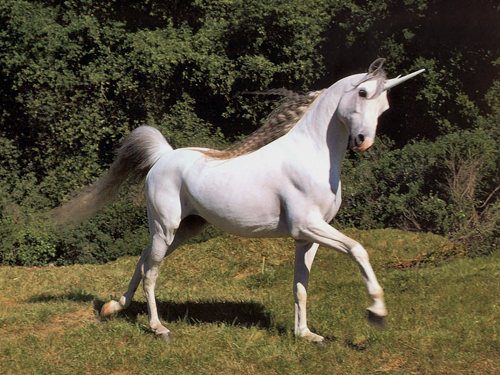
Is this a unicorn? Why or why not?

Thursday, December 08, 2011

Project Capua: Day 2

As we learned yesterday, words trigger many different memories in different minds. The linguistic hypothesis we are testing in this project is that a "word" is the unique location in cognitive space (the hyperdimensional phase space created by every neuron of every hearer and/or reader of that word). If the hypothesis is correct, then "banana" can connote Harry Chapin songs, knock-knock jokes, and innocent Russian children biting through their bitter peels.

Today we'll use the word "rhubarb" to explore another aspect of cognitive space. (I am indebted to Nick Barden, a student at Patrick Henry College, for the discovery of "rhubarbiness.") "Banana" evokes a host of different experiences that generally don't conflict with each other. "Rhubarb," by contrast, tends to evoke contradictory responses. Some people love rhubarb. Some people hate it.

We all know the subjective differences between people. Tastes differ--but does that mean that "everything is relative"? Is there an objective truth about rhubarb?

In our hypothesis, there is an objective truth about something as subjective as rhubarb. If each word is a unique point in the shared cognitive space of every hearer/reader, the contradictory individual opinions about rhubarb tell us something important about that point in cognitive space. In a metaphorical sense, "rhubarb" lies somewhere between the individual observers who collectively make up the logosphere.

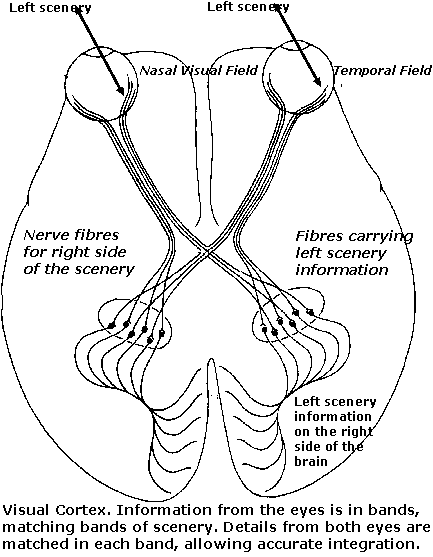
The most familiar analogy for this feature is binocular vision. Two eyeballs gather information about an object from slightly different perspectives which is joined within the vision center of the brain as a three-dimensional scene. The closer the object is to the observer, the more different the two perspectives become. If the object is brought right up to a person's nose, the left eye may not see a single thing that is the same as what the right eye sees.

"Rhubarbiness," using this analogy, means that something is so "close" to different observers that they "see" substantially different images.

Exercise 2:

  • What is your opinion of rhubarb?
  • Pick another word that seems "rhubarby" and explain why.

Wednesday, December 07, 2011

Project Capua: Day 1

Welcome to our first exercise! If you're in a hurry, scroll down to the last paragraph and follow the directions there. If you want to know why you're doing this, read on!

Project Capua is based on a linguistic hypothesis and a metaphysical methodology. The linguistic hypothesis is that words enable the neurons in individual human brains to form a larger network. The participants in the project don't need to understand the new technology of neural networks, but there are a few terms that we'll be using throughout the project that are based on neural network theory.

For purposes of this project, cognitive space means a multi-dimensional phase space composed of every neuron in an interconnected whole. In a system composed of just two neurons, the cognitive space would be a square. Three neurons form a cube. Adding more neurons adds more dimensions, The average human brain has about 100 billion neurons,creating a hyperdimensional phase space.

How "big" is a hundred-billion dimensional phase space? If every neuron can fire at varying rates from 0 to 10, it has a volume of ten to the hundred billionth power. How big is that? Well, the observable universe is about 15 billion light years across (on the order of 10^26 meters) and an electron is 10^-15 meters across. That means you could line up this many electrons in a row across the universe:
100,000,000,000,000,000,000,000,000,000,000,000,000,000
Cube that (10^41 ^3) and you get 10 to the 123rd power. That's how many electrons you can cram into our observable universe. By contrast, you can cram 10 to the 100,000,000,000 power different cognitive states into your brain. Cognitive space is much bigger than space/time!

The linguistic hypothesis behind this project is that words activate the cognitive space of each reader or hearer. For purposes of this project, the word "word" means a unique point in the phase space created by all the neurons in each brain of every reader or hearer.

When I type the word "banana," every neuron in the brain of each reader of this blog is affected to some degree. For most Americans, "banana" conjures up the same basic image of a yellowish green fruit with a little blue sticker on the shelf of the local supermarket, but each one of us adds our own personal experience. I can't say "banana" without humming a Harry Chapin tune. You may remember your grandmother's banana-nut muffins. A political refugee from El Salvador may shudder at the memory of slithering through a field of young banana plants with the death squads hot at her heels.

Exercise 1: Introduce yourself and share a personal experience with bananas.

Tuesday, December 06, 2011

Project Capua: Introduction

Welcome to Project Capua, an experiment in linguistics and metaphysics.

Why experiment? Philosophers at Yale put it this way:
Experimental philosophy, called x-phi for short, is a new philosophical movement that supplements the traditional tools of analytic philosophy with the scientific methods of cognitive science. So experimental philosophers actually go out and run systematic experiments aimed at understanding how people ordinarily think about the issues at the foundation of the philosophical discussion.
Why Capua? This project is inspired by the Siege of Capua in 1098, where St. Anselm of Canterbury met with Muslim soldiers serving under the Norman lord of Sicily. (The Normans conquered Sicily about the same time they conquered England, and Anselm was temporarily in exile because of a church/state dispute with his own Norman king back in Britain.) The Saracen troops had heard reports of Anselm's deep spirituality and were eager to talk theology with him.

We don't know what St. Anselm and the Saracens talked about, but we can imagine--beacuse imagination may well be the core of what they talked about. Anselm defined God as "that being greater than which nothing can be imagined." It's important to be precise here: Wikipedia misquotes Anselm as calling God "the greatest possible being we can conceive."

If Anselm thought God was whatever he imagined, his discussion with the Saracens would have broken down pretty quickly. The two sides would have staked out antithetical positions: "God is One!" "No, God is Three!" "No, God is One!" But if God is that being Who is greater than our imagination, the discussion would be very different.

Imagine Anselm saying something like this:
Muslims say that Allah is one, and Christians call God three. Buddhists seek nirvana more like zero while Hindus worship 330,000,000 deities. Perhaps we are all making the same mistake--using the created category of numbers to count the Uncreated.
This kind of answer is what George Wilhelm Friedrich Hegel would have referred to as a "synthesis." Project Capua is designed to explore the contours of our collective imagination in the spirit of St. Anselm.

Monday, December 05, 2011

Experimental Philosophy Project

Experimental Philosophy is an interesting new approach to an ancient discipline. Most "X-Phi" is done using surveys (similar to psychology), but I'm getting ready for an applied metaphysics project at this site in a few days.

I'm looking for a team of about six VERY different people to participate. I won't disclose the details (because I don't want to skew my test group through selection bias) but I can say this much--it will be an exercise in communication and imagination.

If you might be interested in participating, comment below.

Wednesday, November 30, 2011

Quantum Consciousness

I'll be blogging on this topic soon. Use the comments section to beat me to it!

Tuesday, November 15, 2011

Separating Space from Heaven

Rabbis and Christian theologians alike have noted the absence of the word "good" on the second day of Creation, but have not agreed on why it is not there. The text of Genesis 1:6-8 is facially consistent with a scenario in which the four space/time dimensions "blew out" as the result of the actions of cosmic intelligences.
And God said, "Let there be an expanse in the midst of the waters, and let it separate the waters from the waters." And God made the expanse and separated the waters that were under the expanse from the waters that were above the expanse. And it was so. And God called the expanse Heaven. And there was evening and there was morning, the second day. (Gen. 1:6-8.)
Picture four out of twelve dimensions shattering, with ten times the mass of our observable universe hurtling out into space and time in all directions. Picture the horror and the grief of those intelligences unshaken at the center. This tragedy would separate what we call "Heaven" from what we know as the material universe--and nobody could ever call it "good."