Today we'll use the word "rhubarb" to explore another aspect of cognitive space. (I am indebted to Nick Barden, a student at Patrick Henry College, for the discovery of "rhubarbiness.") "Banana" evokes a host of different experiences that generally don't conflict with each other. "Rhubarb," by contrast, tends to evoke contradictory responses. Some people love rhubarb. Some people hate it.
We all know the subjective differences between people. Tastes differ--but does that mean that "everything is relative"? Is there an objective truth about rhubarb?
In our hypothesis, there is an objective truth about something as subjective as rhubarb. If each word is a unique point in the shared cognitive space of every hearer/reader, the contradictory individual opinions about rhubarb tell us something important about that point in cognitive space. In a metaphorical sense, "rhubarb" lies somewhere between the individual observers who collectively make up the logosphere.
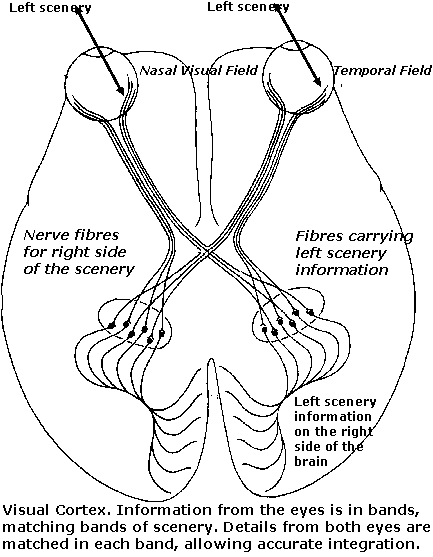 The most familiar analogy for this feature is binocular vision. Two eyeballs gather information about an object from slightly different perspectives which is joined within the vision center of the brain as a three-dimensional scene. The closer the object is to the observer, the more different the two perspectives become. If the object is brought right up to a person's nose, the left eye may not see a single thing that is the same as what the right eye sees.
"Rhubarbiness," using this analogy, means that something is so "close" to different observers that they "see" substantially different images.
Exercise 2:
- What is your opinion of rhubarb?
- Pick another word that seems "rhubarby" and explain why.


