Today is the reason I am a Christian.
Something happened on the first Easter Sunday (AD 30 or so) that demands an explanation. Every explanation I come up with keeps coming back to the same point--something BIG happened that so changed the life of eleven demoralized disciples that they went out and changed the world.
The liberal Protestants of the late 19th and early 20th centuries did their best to reconcile the science of their day with the fact of the Church. The liberal theologians had no objection to discounting any specific text of Scripture. They would have been perfectly comfortable with a humanistic explanation for anything. I have read a lot of their writings and find them ultimately unsatisfying. Their naturalistic paradigm just doesn't cover all the facts.
Perhaps they did the best they could with the science at hand. Twenty-first century science includes so many options our "modern" forbears never knew. They were hobbled by a physics in which miracles were impossible. We now are taught that nothing is impossible--its just a matter of quantum statistics. A man could walk on water if every water molecule rose to the surface at just the right moment. A man could rise from the dead if the quantum wave-function collapsed in that direction.
Given a physics which no longer rules out the story in the Gospels, what should a serious scientist make of Easter? It may be asking too much to expect him or her to dig through historical records to decide whether the eleven eyewitnesses were telling the truth about an empty tomb and a resurrected Christ.
If Christ did rise from the dead, reality should reflect it in a hundred ways that are incompatible with the merely naturalistic worldview that now characterizes science. I will be looking for those anomalies here, and invite believers and skeptics alike to help me think rigorously about the evidence for and against the resurrection.
- Posted using BlogPress from my iPhone
Sunday, April 08, 2012
Saturday, April 07, 2012
The Punctuated Participatory Anthropic Principle
- John Wheeler came up with the "Participatory Anthropic Principle," in which the entire early universe expands as one vast collection of entangled particles until an "observer" becomes one of the quantum possibilities, at which point that "observer" observes itself into actuality.
- What Wheeler failed to note was the "petunia problem" (citing Douglas Adams in Hitchhiker's Guide to the Galaxy, where a sperm whale and a bowl of petunias appear in mid-air and then crash to the ground). An "observer" can exist long enough to "collapse the quantum wavefunction" yet not be able to exist very long after that. Wheeler's original Participatory Anthropic Principle must be modified into a Punctuated Participatory Anthropic Principle ("PPAP") in light of this problem.
- A PPAP should leave a distinctive trail in the genome that is as recognizable as the trail a subatomic particle leaves in a bubble chamber. This is because there are two kinds of "evolution" in operation--an "observer-driven evolution" that defies all odds as it produces the most intelligent organism possible in the shortest possible time, and a random "devolution" that cascades down from these more advanced organisms.
- On Earth, PPAP would predict some radical anomalies in the fossil record. There should be a few impossibly advanced species very early in the fossil record, with many variations radiating out from that ancestral stock. (This goes directly against the Darwinian model of long, slow growth towards the more advanced species.)
- The secular scientists should be able to take the model and look for anomalies. The most obvious ones are (a) the sudden appearance of life on earth which leads some to suggest some form of panspermia, (b) the radical diversification of multicellular animal life in the Cambrian Explosion, and (c) the perplexingly early appearance of birds in the fossil record.
- PPAP suggests that humans are not the only intelligent life-forms in the universe. This means that even the most secular scientists might want to take a second look at the book of Genesis. Genesis 1 might not be just a man-made myth; it could contain a communication from another intelligence (whether God, "angels," "fallen angels," or extra-terrestrial biological beings). PPAP makes it possible for secular people to consider the account of Genesis 1 as reliable information about a pre-human history.
- When we add Scripture to this reasoning, we get more specific about what to look for in the fossil and/or DNA record. Genesis 1 tells us that flowering plants appeared before the sun (1:11), the lights in the heavens appeared for signs and seasons (1:14), and birds appeared before land animals (1:20).
- If flowering plants appeared before the sun, they must have appeared on some other planet. This suggests that pollen grains can travel between the stars. There is very little research on this topic (it is known as "reverse panspermia"), so I can't say whether it is possible or not--just that it is a falsifiable prediction of the PPAP hypothesis.
- If the sun, moon, and stars appeared for signs and for seasons in a PPAP universe, an "observer" probably observed them. Modern molluscs have a camera eye that is startlingly similar to the vertebrate eye. Octopi are unbelievably intelligent-- but have terribly short lifespans (one or two years). They don't leave much in the way of fossils, so we need to look at the modern DNA to hunt for an common ancestor to link the vertebrate eye with a Cambrian observer.
- Birds are the easiest observer to find in the fossil record. Avian intelligence is very high, and bird bones are preserved often enough to suggest that dinosaurs descended from birds, not vice versa. The "birds came first" theory is based solely on fossil evidence, not any Scripture--but Genesis 1:20 fits perfectly with PPAP.


Tuesday, December 13, 2011
Project Capua Suspended

After evaluating last week's interactions, I'm more convinced than ever that my experimental philosophy project is worth doing, but I'm convinced it can't be done on a blog. A blog tends to produce "star-shaped" interactions (which means all the commenters interact with the poster at the center) or "bi-polar" interactions (in which two commenters engage in a verbal dogfight). Project Capua can't work unless the participants develop a "spirograph" pattern of interactions, and I don't see a way to get there from here.
I'd love to try this again sometime, but I think we'd all need to spend at least week together to lay the foundation for the conversation we could have.
Friday, December 09, 2011
Thursday, December 08, 2011
Project Capua: Day 2
As we learned yesterday, words trigger many different memories in different minds. The linguistic hypothesis we are testing in this project is that a "word" is the unique location in cognitive space (the hyperdimensional phase space created by every neuron of every hearer and/or reader of that word). If the hypothesis is correct, then "banana" can connote Harry Chapin songs, knock-knock jokes, and innocent Russian children biting through their bitter peels.
Today we'll use the word "rhubarb" to explore another aspect of cognitive space. (I am indebted to Nick Barden, a student at Patrick Henry College, for the discovery of "rhubarbiness.") "Banana" evokes a host of different experiences that generally don't conflict with each other. "Rhubarb," by contrast, tends to evoke contradictory responses. Some people love rhubarb. Some people hate it.
We all know the subjective differences between people. Tastes differ--but does that mean that "everything is relative"? Is there an objective truth about rhubarb?
In our hypothesis, there is an objective truth about something as subjective as rhubarb. If each word is a unique point in the shared cognitive space of every hearer/reader, the contradictory individual opinions about rhubarb tell us something important about that point in cognitive space. In a metaphorical sense, "rhubarb" lies somewhere between the individual observers who collectively make up the logosphere.
 The most familiar analogy for this feature is binocular vision. Two eyeballs gather information about an object from slightly different perspectives which is joined within the vision center of the brain as a three-dimensional scene. The closer the object is to the observer, the more different the two perspectives become. If the object is brought right up to a person's nose, the left eye may not see a single thing that is the same as what the right eye sees.
"Rhubarbiness," using this analogy, means that something is so "close" to different observers that they "see" substantially different images.
Today we'll use the word "rhubarb" to explore another aspect of cognitive space. (I am indebted to Nick Barden, a student at Patrick Henry College, for the discovery of "rhubarbiness.") "Banana" evokes a host of different experiences that generally don't conflict with each other. "Rhubarb," by contrast, tends to evoke contradictory responses. Some people love rhubarb. Some people hate it.
We all know the subjective differences between people. Tastes differ--but does that mean that "everything is relative"? Is there an objective truth about rhubarb?
In our hypothesis, there is an objective truth about something as subjective as rhubarb. If each word is a unique point in the shared cognitive space of every hearer/reader, the contradictory individual opinions about rhubarb tell us something important about that point in cognitive space. In a metaphorical sense, "rhubarb" lies somewhere between the individual observers who collectively make up the logosphere.
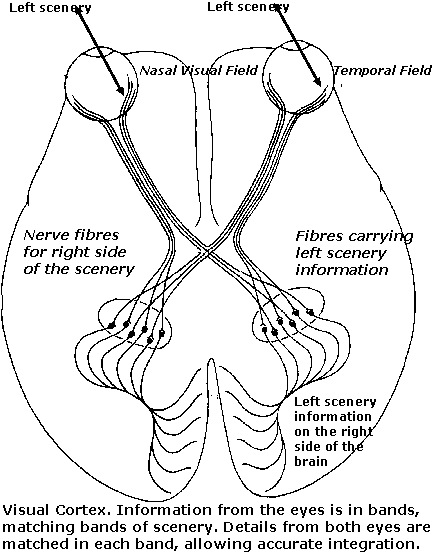 The most familiar analogy for this feature is binocular vision. Two eyeballs gather information about an object from slightly different perspectives which is joined within the vision center of the brain as a three-dimensional scene. The closer the object is to the observer, the more different the two perspectives become. If the object is brought right up to a person's nose, the left eye may not see a single thing that is the same as what the right eye sees.
"Rhubarbiness," using this analogy, means that something is so "close" to different observers that they "see" substantially different images.
Exercise 2:
- What is your opinion of rhubarb?
- Pick another word that seems "rhubarby" and explain why.
Wednesday, December 07, 2011
Project Capua: Day 1
Welcome to our first exercise! If you're in a hurry, scroll down to the last paragraph and follow the directions there. If you want to know why you're doing this, read on!
Project Capua is based on a linguistic hypothesis and a metaphysical methodology. The linguistic hypothesis is that words enable the neurons in individual human brains to form a larger network. The participants in the project don't need to understand the new technology of neural networks, but there are a few terms that we'll be using throughout the project that are based on neural network theory.
For purposes of this project, cognitive space means a multi-dimensional phase space composed of every neuron in an interconnected whole. In a system composed of just two neurons, the cognitive space would be a square. Three neurons form a cube. Adding more neurons adds more dimensions, The average human brain has about 100 billion neurons,creating a hyperdimensional phase space.
How "big" is a hundred-billion dimensional phase space? If every neuron can fire at varying rates from 0 to 10, it has a volume of ten to the hundred billionth power. How big is that? Well, the observable universe is about 15 billion light years across (on the order of 10^26 meters) and an electron is 10^-15 meters across. That means you could line up this many electrons in a row across the universe:
The linguistic hypothesis behind this project is that words activate the cognitive space of each reader or hearer. For purposes of this project, the word "word" means a unique point in the phase space created by all the neurons in each brain of every reader or hearer.
When I type the word "banana," every neuron in the brain of each reader of this blog is affected to some degree. For most Americans, "banana" conjures up the same basic image of a yellowish green fruit with a little blue sticker on the shelf of the local supermarket, but each one of us adds our own personal experience. I can't say "banana" without humming a Harry Chapin tune. You may remember your grandmother's banana-nut muffins. A political refugee from El Salvador may shudder at the memory of slithering through a field of young banana plants with the death squads hot at her heels.
Exercise 1: Introduce yourself and share a personal experience with bananas.
Project Capua is based on a linguistic hypothesis and a metaphysical methodology. The linguistic hypothesis is that words enable the neurons in individual human brains to form a larger network. The participants in the project don't need to understand the new technology of neural networks, but there are a few terms that we'll be using throughout the project that are based on neural network theory.
For purposes of this project, cognitive space means a multi-dimensional phase space composed of every neuron in an interconnected whole. In a system composed of just two neurons, the cognitive space would be a square. Three neurons form a cube. Adding more neurons adds more dimensions, The average human brain has about 100 billion neurons,creating a hyperdimensional phase space.
How "big" is a hundred-billion dimensional phase space? If every neuron can fire at varying rates from 0 to 10, it has a volume of ten to the hundred billionth power. How big is that? Well, the observable universe is about 15 billion light years across (on the order of 10^26 meters) and an electron is 10^-15 meters across. That means you could line up this many electrons in a row across the universe:
100,000,000,000,000,000,000,000,000,000,000,000,000,000Cube that (10^41 ^3) and you get 10 to the 123rd power. That's how many electrons you can cram into our observable universe. By contrast, you can cram 10 to the 100,000,000,000 power different cognitive states into your brain. Cognitive space is much bigger than space/time!
The linguistic hypothesis behind this project is that words activate the cognitive space of each reader or hearer. For purposes of this project, the word "word" means a unique point in the phase space created by all the neurons in each brain of every reader or hearer.
When I type the word "banana," every neuron in the brain of each reader of this blog is affected to some degree. For most Americans, "banana" conjures up the same basic image of a yellowish green fruit with a little blue sticker on the shelf of the local supermarket, but each one of us adds our own personal experience. I can't say "banana" without humming a Harry Chapin tune. You may remember your grandmother's banana-nut muffins. A political refugee from El Salvador may shudder at the memory of slithering through a field of young banana plants with the death squads hot at her heels.
Exercise 1: Introduce yourself and share a personal experience with bananas.
Subscribe to:
Posts (Atom)
